AI
How to Build More Realistic ETAs Using Entrance, Parking, and Final-Stop Data


Most ETAs look more precise than they really are.
A customer sees a message that the parcel will be 8 minutes. A dispatcher sees a vehicle approaching the delivery point. A routing system considers the stop almost complete because the driver is close to the address. But in real last-mile delivery, the hardest part often starts exactly there.
The driver has reached the street, but not the customer. They still need to find the right side of the building, locate a usable stopping point, identify the correct entrance, walk through an access path, handle a gate or reception desk, call the customer if instructions are unclear, complete the handoff, and upload proof of delivery.
That is why realistic ETAs are crucial for the modern delivery architecture. A realistic ETA is not the time to the address. It is time to complete the delivery.
Why address-level ETAs are not enough
Traditional ETA logic is usually built around road distance, traffic, speed, and the address pin. These inputs are useful, but they often stop too early. They estimate when the vehicle gets near the destination, not when the delivery is actually done.
For last-mile delivery teams, this difference matters.
A generic address pin may point to the center of a building instead of the delivery-relevant entrance. The fastest driving route may bring the driver to the wrong side of the road. The map may not know where the driver can safely stop, whether there is a pedestrian-only zone, a gate, a long driveway, a loading area, or a confusing building layout.
Naurt, in their article, describes this gap clearly: delivery drivers do not just need to navigate to an address; they also need to know where to park and where to drop off the parcel at that address. Wasted time at this stage directly affects route performance across the fleet.
This is where the delivery ETA accuracy is often wrong. The system says the driver has arrived. The customer is still waiting. The dispatcher sees a stop that should be almost complete. The driver is still circling the block.
The issue is not always poor routing software. Often, the route is doing exactly what it was designed to do: get the vehicle near the address. But last-mile delivery does not end at the address. It ends when the parcel, order, or service is successfully handed over and confirmed.
What final-stop data adds to ETA logic
To make ETAs more realistic, delivery teams need to model the delivery as an operational process, not just a driving task.
That means ETA logic should include several segments:
- Drive time to the delivery area.
- Stopping or parking time.
- Walking and access time.
- Service or handoff time.
- Proof-of-delivery completion time.
Final-stop data helps bridge the gap between the vehicle's arrival and the completed delivery.
Entrance data shows the driver where the delivery should actually happen. Parking data helps identify where the vehicle should stop to complete the delivery efficiently. Walking distance and access complexity help estimate what happens after the driver leaves the vehicle. Historical driver behavior can show which delivery points consistently take longer than expected.
Naurt’s product positioning is built around this final-destination intelligence. Its geocoder provides delivery-relevant information, such as where to park and where the door is, rather than only pointing to the building's center. Naurt also explains that its database includes optimal parking spots and building entrances for addresses, helping route-planning tools estimate how long it takes to complete the final 100 meters of a delivery.
This is the important shift: the final meters become measurable. Once they are measurable, they can be included in ETA logic, driver apps, dispatch dashboards, customer notifications, and performance analytics.
The power of collaboration between ElifTech and Naurt
Naurt provides the final-destination layer: entrance data, parking data, geocoding, API access, SDK capabilities, and last-mile delivery intelligence. Its data can help delivery systems route drivers to a more useful operational endpoint, not just a generic coordinate. Their delivery apps can use their HTTP API to route drivers to a parking zone and display building entrances on the map.
ElifTech’s role is different but complementary. ElifTech helps logistics companies turn this kind of data into working operational software: routing systems, driver apps, dispatch dashboards, analytics layers, automation workflows, and integrations with TMS, OMS, WMS, carrier systems, and internal tools.
This matters because better data alone does not automatically improve operations. It has to be embedded into the systems people actually use every day.
For example, a driver app can show the recommended stopping point and entrance before the driver reaches the destination. A dispatch dashboard can flag stops where the final-meter gap is consistently high. A customer notification system can adjust delivery windows based on service time, not only drive time. A routing engine can include final-stop buffers by building type, area, or historical completion behavior.
ElifTech’s logistics software development services cover supply chain software, third-party integrations, data analytics, reporting, route optimization, workflow automation, and real-time operational visibility.
This partnership brings powerful results. Naurt improves the precision of the destination. ElifTech helps make that precision operational.
How to build more realistic ETAs in practice
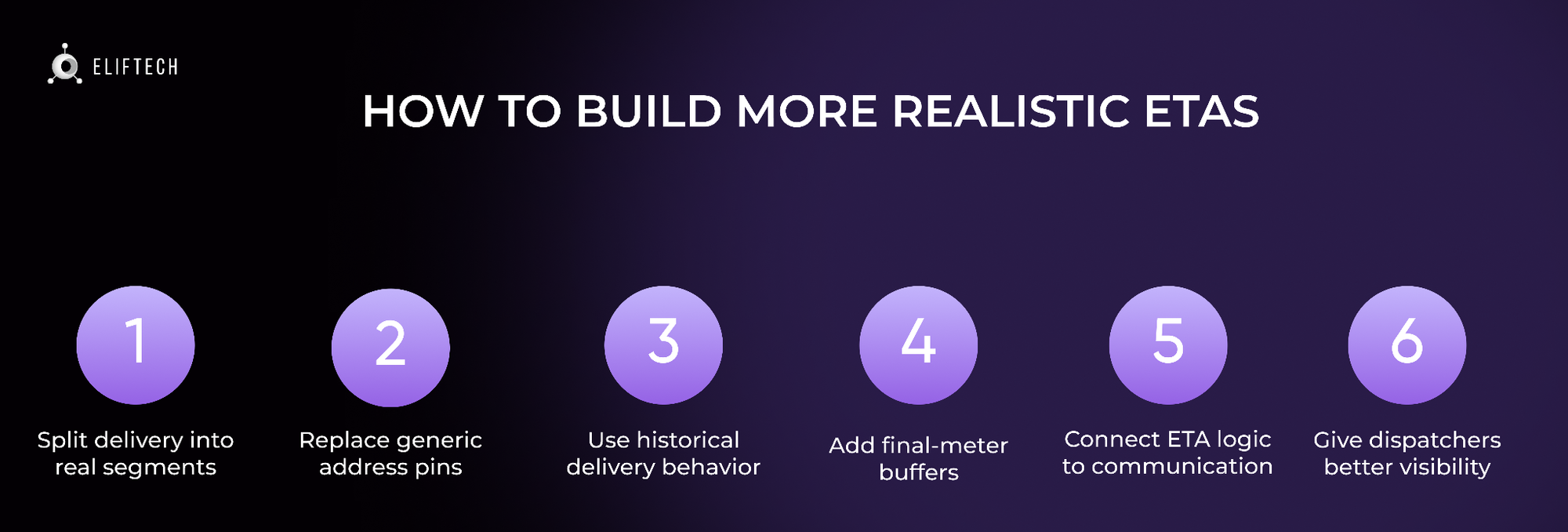
The first step is to split delivery into real operational segments. Instead of treating a stop as a single block of time, break it down into drive time, parking or stopping time, walking/access time, handoff time, and proof-of-delivery time. This helps teams see where ETA gaps actually happen.
The second step is to replace generic address pins with delivery-relevant endpoints. A central location in a building is not enough if the driver needs to reach a side entrance, reception desk, loading area, or front door. Routing software should understand where the delivery should be completed, not only where the address exists on a map.
The third step is to use historical successful delivery behavior. If drivers repeatedly complete deliveries faster at one stopping point than at another, that information should feed into the ETA model. If one building always adds 4 minutes due to access complexity, the ETA should not pretend to behave like a simple residential doorstep.
The fourth step is to add final-meter buffers by location type. A small house, apartment complex, shopping center, office building, gated community, hospital, campus, or dense urban block will not have the same completion time as the others. ETA logic should reflect that operational reality.
The fifth step is to connect the ETA logic to communication. A better ETA is not only an internal planning metric. It affects the promise made to the customer. If the system knows that the driver has reached the parking point but still needs several minutes to complete the handoff, customer notifications should reflect that.
The final step is dispatcher visibility. Dispatchers should not only see where the vehicle is. They should see where delays are likely to happen, which stops repeatedly create ETA gaps, and where driver support may be needed.
How customers can test this in their own operation
A company does not need to rebuild its entire last-mile delivery stack to test whether final-stop data can improve ETA accuracy.
Start with one zone, route type, city area, or customer segment.
First, compare two points: “vehicle arrived” versus “delivery completed.” This is the simplest way to expose the final-meter gap. If the vehicle arrives at 10:02 but proof of delivery is completed at 10:11, your ETA model is missing 9 minutes of actual delivery time.
Second, identify the locations with repeated ETA gaps. Look for stops where the planned ETA is often accurate until arrival, but completion time regularly runs late. These are usually the places where parking, entrance search, walking distance, building complexity, or access issues are affecting performance.
Third, collect driver feedback. Ask simple operational questions: Was the entrance clear? Was parking available? Did the pin take you to the wrong side of the building? Did you need to call the customer? Was there a gate, reception process, or long walking path?
Fourth, run an A/B pilot. Compare one group of routes using standard address-level ETA logic with another group using improved final-stop data and adjusted completion-time logic.
Measure delivery ETA accuracy, average delivery completion time, deliveries per hour, failed attempts, customer support calls, driver calls, and dispatcher interventions. These metrics will show whether the improved ETA is only more precise on paper or actually better for operations.
The best test is whether drivers complete stops faster, customers receive more reliable communication, and dispatchers intervene less often.
Customers do not experience ETA as a coordinate
Improving ETA accuracy is not only about generating better traffic data or optimizing routes faster. Those are still important, but they don’t solve the last-meter challenge by themselves.
Last-mile delivery lives in the messy space between the road and your customer. That means parking, entrances, walking paths, gates, handoffs, customer contact, and proof-of-delivery workflows. A realistic ETA needs to account for all of that.
For logistics teams, this shifts the question. It’s not knowing when the driver will reach the address, but when the delivery will actually be done.
That’s the difference between an ETA that looks accurate in the system and one that actually feels reliable to your customer.
