Logistics
Keeping Routes on Track with Real-Time Re-Optimization


Introduction
Field service and last-mile delivery teams are facing immediate changes in their operating environment. Customers increasingly expect same-day or near-instant service, while real-world disruptions such as traffic congestion, weather conditions, or urgent order changes constantly affect daily plans. In this context, fixed and pre-planned routes often fail to keep deliveries and service appointments on schedule.
Real-time route re-optimization addresses this challenge by continuously adjusting routes and schedules in response to real-time conditions throughout the day. Instead of relying on static plans, dispatchers and drivers can respond dynamically to disruptions as they happen.
The Problem with Traditional Scheduling
Static route planning, once the basis of delivery operations, is increasingly a liability in a fast-paced logistics landscape. Fixed schedules assume everything will go smoothly, but that rarely happens by the end of the day. A traffic jam or vehicle breakdown can cause delays that affect many deliveries, making it hard for the operation to keep up. In an era of next-day and same-day delivery, a preplanned route set for dawn may be obsolete by noon if orders change, customers cancel, or road conditions worsen. The result is wasted miles and late arrivals that erode efficiency and customer trust.
1. Traditional routing depends on forecasts and static assumptions made well in advance. For teams that schedule mobile workers, such as field service technicians or last-mile delivery drivers, this rigidity often fails in real-world operations. Plans created hours or days in advance assume stable conditions and fixed job lists, yet daily operations are highly dynamic: new service requests arrive, appointments run over, traffic varies, and customer availability changes. What looked like an optimal route at the start of the day can quickly become inefficient or unworkable.
Static schedules lock mobile workers into a predefined sequence of tasks, leaving no flexibility to adapt to changes. This leads to missed time windows, increased travel time, higher operational costs, and stressed dispatch teams. Modern scheduling must support continuous adaptation of routes and assignments throughout the day, enabling real-time insertion of new jobs and reoptimization based on current conditions. Solutions such as real-time scheduling APIs enable dynamic adjustments for field service and last-mile delivery, helping teams maintain service levels even when plans change.
2. Relying on manual scheduling or fixed routes often reveals weaknesses under pressure. Routes built manually or planned as fixed sequences leave little room for error. In field service operations, a single job running longer than expected can immediately affect the rest of the day. For example, when a technician spends extra time resolving an issue at one customer site, they may arrive late to the next appointment, resulting in missed time windows, customer dissatisfaction, and additional rescheduling work for dispatchers.
The same applies to last-mile delivery: unexpected congestion or delays at one stop can cause orders to pile up and vehicles to become overextended, creating a domino effect across the route. Because static schedules cannot adjust proactively, problems are addressed only after service levels have already been impacted, increasing operational stress and reducing overall efficiency.
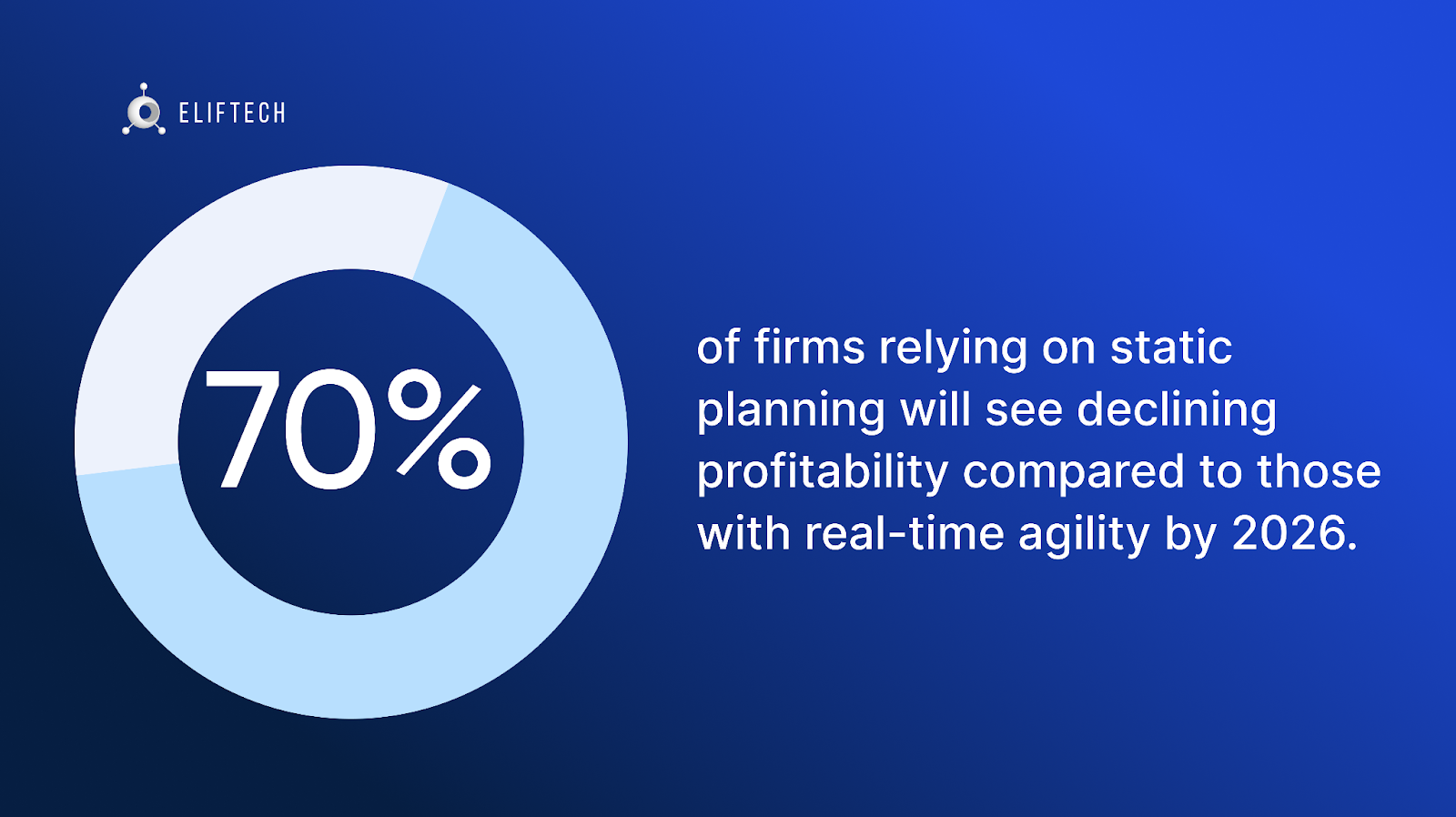
Traditional scheduling is struggling to meet the demands of modern field service and last-mile operations. Static route planning cannot accommodate the day-to-day volatility of mobile workforces, where traffic conditions, job durations, and incoming requests change throughout the day. The industry shift is therefore not about predicting the future more accurately, but about responding to change faster when it happens.
Real-time dynamic scheduling addresses this gap by continuously re-optimizing routes and task assignments as conditions evolve. Instead of relying on fixed plans, organizations can adapt schedules during execution, keeping mobile workers productive and service levels intact. In the next section, we explore how real-time scheduling works and why it outperforms static approaches.
Real-Time Scheduling as the Dynamic Solution
Static plans can be tough, while real-time scheduling offers flexibility, focusing on responsiveness. Dynamic route optimization recalculates routes on the fly whenever conditions change, ensuring deliveries stay on track despite daily disruptions. Instead of planning routes just once and hoping for the best, logistics teams now utilize software that continuously updates the optimal route plan as new data becomes available. Has a delivery address suddenly become unreachable? Did a new high-priority order arrive? Advanced routing platforms can quickly reroute drivers, resequence stops, or reassign loads to keep everything on track. In other words, routes change in real time rather than being managed on someone’s clipboard.
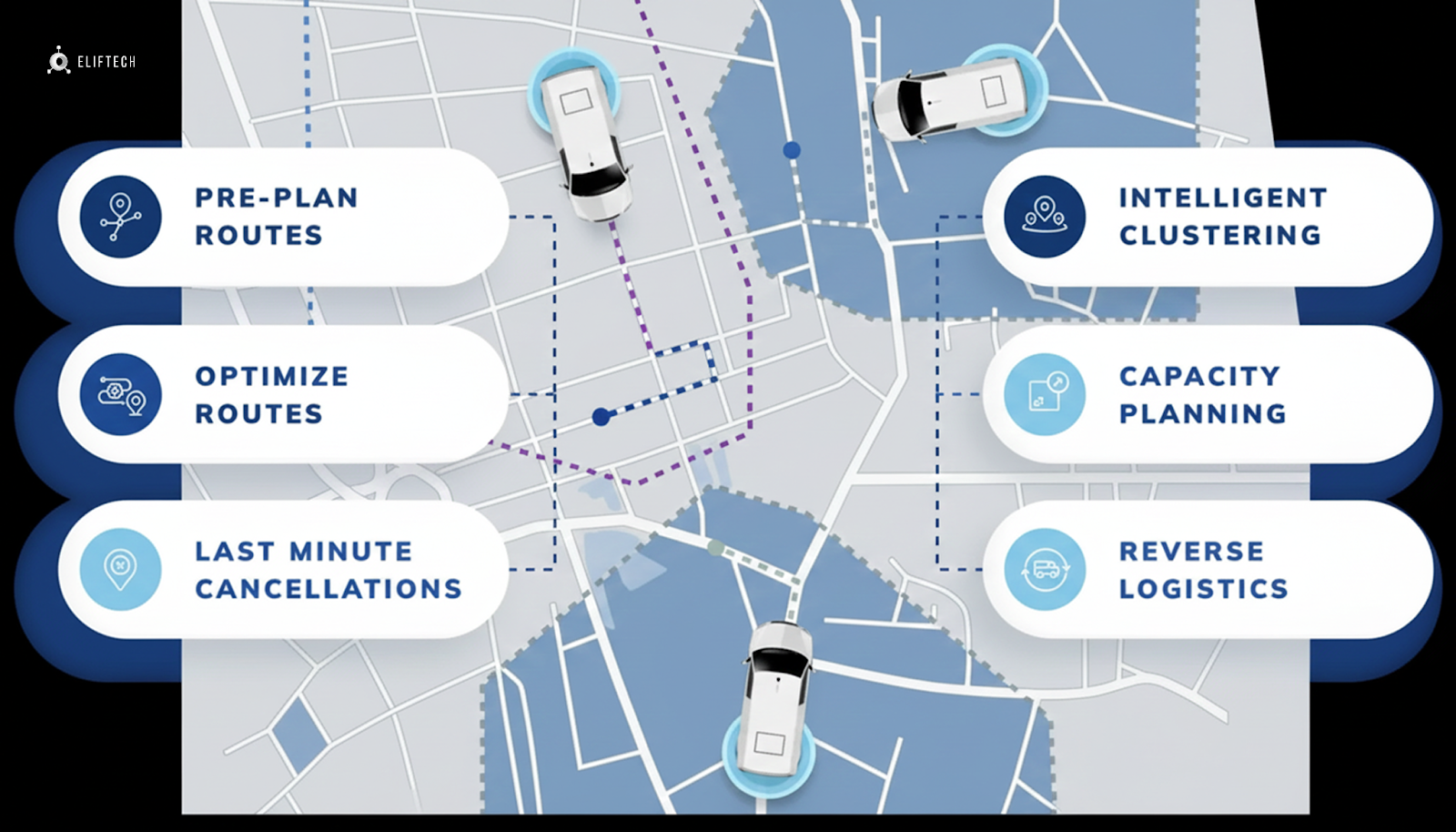
This dynamic approach represents a fundamental shift in mindset. Routing is no longer a set-and-forget task; it has become a continuous process that operates throughout the day. Companies around the world are adopting this change, with teams actively transitioning from static plans to dynamic operations. They recognize that routing is now one of the most critical factors for service and efficiency. A static plan may optimize stops for this morning, but a dynamic system continuously optimizes stops for the next hour as conditions evolve. Real-time scheduling functions like a living “control tower,” processing GPS feeds, traffic alerts, and order changes while providing updated driving instructions to the field.
Dynamic routing is also smarter. Modern route optimization engines use AI and extensive data streams to make decisions that human dispatchers or traditional routing models might overlook. These systems can anticipate issues, such as standard stoppages on the route ahead, and change proactively. They also optimize resource usage by, for example, reassigning a delivery from a delayed driver to a nearby driver who is ahead of schedule. The result is a more resilient operation. When challenges arise in logistics, they inevitably do, and the best systems can reroute in real time to minimize impact. This dynamic flexibility transforms what used to be daily crises into manageable speed bumps that the network can adapt to.
Many people view real-time routing as a revolutionary solution for businesses. Companies that used to struggle to expedite shipments or apologize to customers for delays can now proactively manage exceptions and optimize their processes in real time.
How Real-Time Re-Optimization Works
Achieving dynamic, real-time routing might sound complex, but the fundamentals can be broken down into a few key components. Modern route re-optimization platforms combine continuous data feeds, smart algorithms, and feedback loops to keep routes optimal throughout the day.
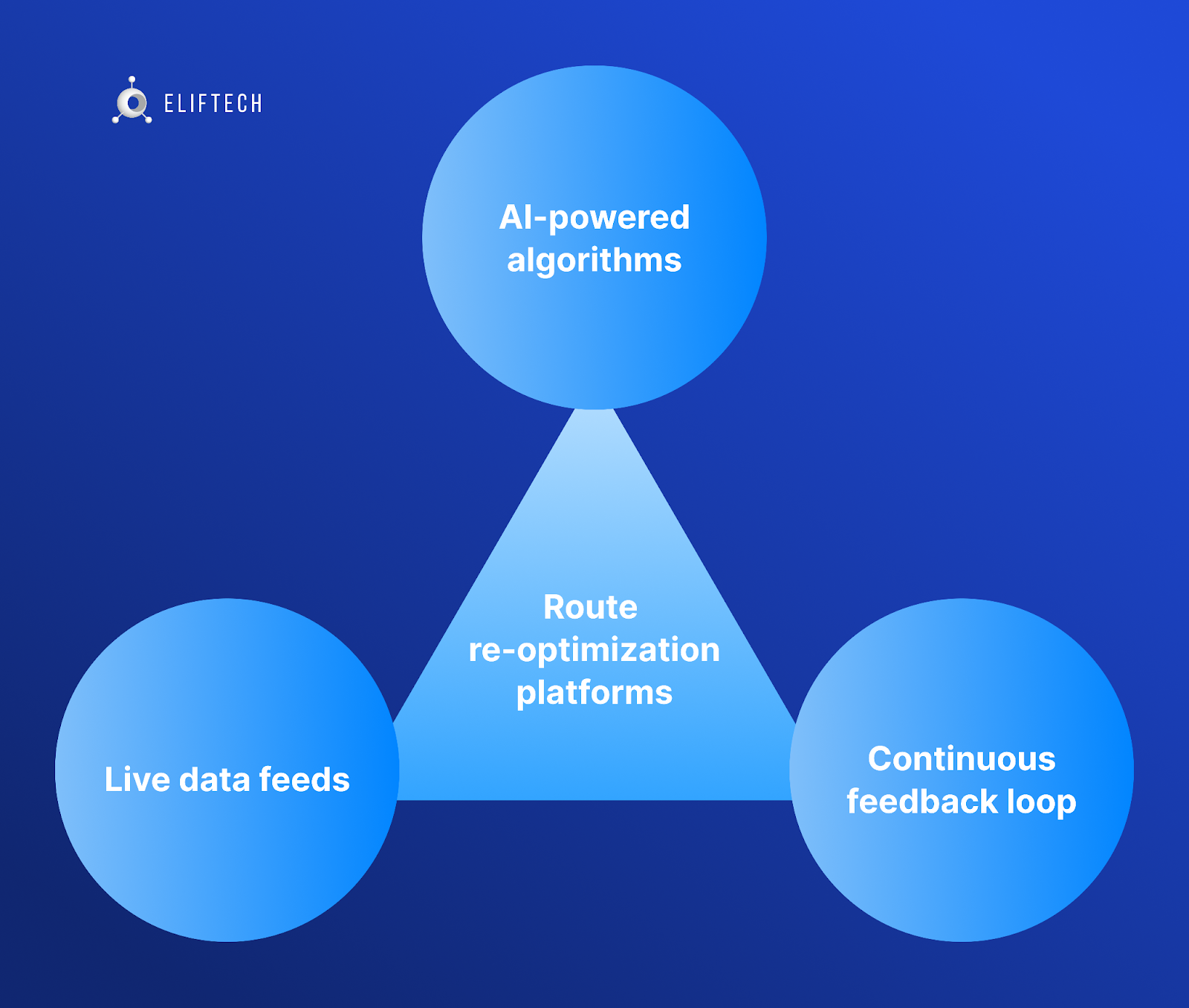
1. Live data feeds.
Real-time routing systems actively gather live data from various aspects of operations. This includes GPS tracking for each vehicle, providing up-to-the-second location and speed information, as well as traffic monitoring APIs that deliver alerts about traffic jams, accidents, or road closures. Additionally, weather services provide forecasts and storm alerts, which help the system adjust for sudden rain or snow that may slow down traffic. Importantly, the routing software connects with order and field service management systems. If a customer cancels, adds a new order, or changes a delivery time window, the system responds immediately by making the necessary adjustments. By integrating these live data streams, dynamic optimizers maintain an accurate and up-to-date view of reality, in contrast to static plans based on outdated information.
2. AI-powered algorithms.
At the core of real-time re-optimization are advanced algorithms that quickly process data. As new information comes in, the system must decide whether and how to adjust routes. This is where heuristics and AI techniques are applied. Modern routing engines use AI and machine learning to evaluate numerous route possibilities within milliseconds and identify the best option. They take into account various factors such as driver shift hours, vehicle capacity, and delivery time commitments, solving a significant optimization challenge in near-real time.
3. Continuous feedback loop.
The optimization process evaluates a large number of possible routing scenarios during planning and selects the best solution based on defined constraints and objectives such as time, capacity, and cost. Operational data may be used as input parameters for future planning, but each optimization run independently searches the solution space rather than improving through a post-route feedback loop.
For example, if drivers frequently report that a particular delivery location is difficult to access and causes delays, the system can learn to allocate extra time for that stop or schedule it at a different point in the route. Similarly, if a new “hot order” added at 11 AM often leads to downstream delays, the software can simulate different preemptive adjustments, such as swapping stops between drivers, to manage mid-day additions more effectively next time.
This cycle of continuous improvement means that the routing system becomes smarter and more efficient with each iteration, unlike static planning methods that do not learn from their mistakes.
So, real-time re-optimization integrates data and algorithms to provide users with updated route plans or turn-by-turn instructions whenever needed. Systems often send automatic notifications to drivers' mobile apps when routes change during their shifts. This feature acts like a co-pilot, suggesting timely adjustments such as, “Take a left here to save 10 minutes due to an accident,” or “Skip Stop #5 and head to Stop #6 because the customer isn’t home yet.”
The complex recalculations happen in the cloud or onboard computers, enabling drivers to follow directions that ensure each stop is optimal. These systems also provide a comprehensive view of fleet operations, enabling proactive rerouting to address delays. For field service teams, if a job runs late, dispatchers receive automatic recommendations to reassign appointments to available technicians, effectively balancing workloads in real time. Finally, this technology coordinates deliveries and service calls efficiently, keeping routes on track no matter the day's challenges.
Tangible Benefits for Field Service Operations and Last-Mile Delivery
Real-time route re-optimization provides tangible, measurable improvements in operations. Companies that have implemented dynamic routing report significant improvements in efficiency, cost savings, and customer satisfaction. These benefits are evident in both last-mile delivery fleets and field service operations, positively affecting both profitability and service quality.
For last-mile delivery teams, numbers are significant. When executed effectively, route optimization can reduce delivery costs by 20–30% and improve on-time delivery to 95% or higher. By dynamically reducing unnecessary detours and idle time, fleets travel fewer miles to deliver the same or more packages. In fact, logistics companies that use real-time routing often report reductions in mileage of up to 20% in their daily operations. Fewer miles traveled directly translates to fuel saved, and with fuel typically consuming 10–25% of last-mile operating expenses. For instance, UPS's advanced routing system, known as ORION, saves an estimated 10 million gallons of fuel each year and reduces the average route by 6 to 8 miles. With the addition of real-time dynamic re-optimization, it further shortens each route by an additional 2 to 4 miles. That level of efficiency added up to $300–$400 million in savings each year for UPS.
Speed and reliability metrics improve as well. Customers see faster, more predictable deliveries when routes adapt to avoid delays. For example, DHL reported a 15% increase in on-time deliveries and a 20% drop in shipment delays after adopting AI-powered route planning as part of its platform.
Field service organizations, such as utilities and repair technicians, are benefiting from dynamic job scheduling and routing. This approach allows technicians to spend more time with customers and less time driving, resulting in more service calls completed daily, better on-time performance, and reduced overtime.
A major advantage is the real-time matching of technicians to jobs. If a specialist finishes a job early, they can be quickly reassigned to a nearby call that needs their skills, minimizing downtime. If a technician is delayed, their later appointments can be reassigned to others, preventing customer delays.
This efficient scheduling reduces missed appointments and service level agreement violations, enhancing overall service metrics. Plus, it helps prevent technicians from feeling overworked or underutilized, as workloads are balanced effectively.
Operational gains are essential for customer satisfaction and retention. In field services, missed appointments or delays can damage customer trust. Dynamic routing helps prevent these issues by keeping schedules updated and realistic. Effective route optimization reduces travel time, improves technician performance, and lowers customer churn, creating an operation that stays in control even with frequent schedule changes.
Being able to quickly respond to unexpected events, like emergency repairs or canceled jobs, ensures high service levels throughout the day. Customers appreciate timely updates such as “technician en route” or “new ETA due to traffic,” leading to dependable service instead of mere apologies.
Real-time re-optimization offers significant benefits, including cost savings in fuel and labor, increased delivery throughput, and improved service ratings. It also aids sustainability by reducing carbon emissions through shorter routes and less idling. Some planning tools even focus on minimizing carbon impact while enhancing efficiency. Whether running a courier fleet or managing field engineers, using real-time optimization can lead to measurable improvements in performance and profitability.
Expert Insights
To better understand how real-time re-optimization works in practice, and what truly differentiates effective solutions from static planning tools, we spoke with Bert Van Wassenhove, CEO at Solvice.
Solvice specializes in advanced optimization technologies for logistics and field operations, helping companies move from rigid planning to dynamic, execution-aware routing.
Bert shares his perspective on the real challenges behind route optimization, why many implementations fall short, and what organizations need to get right to make real-time scheduling work at scale.
Where do you see the biggest challenges or inefficiencies in route optimization today?
The biggest inefficiencies I see today come from organizations treating routing as a one-time exercise. Many companies still schedule once and never update, even though reality changes constantly throughout the day.
Another major issue is designing routes that ignore driver preferences and on-the-ground realities. When routes don’t reflect how work is actually done, drivers simply stop following them, and the plan loses value immediately.
Finally, technology alone isn’t enough. There is often a lack of proper change management for managers, schedulers, drivers, or technicians. Without bringing people along in the transition to dynamic routing, even the best optimization systems will struggle to deliver results.
What role does innovation play in helping companies optimize routes and reduce spending?
Route optimization is a proven and mature technology. The real innovation today lies in how well we can model real-life complexity. By adding the right constraints, routes and schedules begin to reflect actual operating conditions and respond to the unique challenges each organization faces, rather than how we assume they should function on paper.
Another important shift is accessibility. Modern optimization solvers are significantly easier to implement and can be integrated off the shelf through APIs. This lowers the barrier to adoption and allows companies to move faster, reduce costs sooner, and scale optimization across their logistics networks.
What challenges do companies typically face when trying to implement real-time route technologies?
The biggest challenge is that many existing systems were never designed for dynamic scheduling. They rely on batch planning and cannot support continuous updates during execution.
Change management is another critical hurdle. Moving to real-time routing requires new ways of working for managers, schedulers, and drivers, and without proper adoption, even strong technology can fail.
Finally, performance still matters. If route optimization technology is too slow to respond, it simply can’t keep up with real-world changes, making real-time re-optimization impractical.
How can companies balance the upfront investment in real-time tech with the long-term financial benefits it delivers?
Real-time optimization is not necessarily more expensive; it mainly requires the right effort and focus during implementation. With modern, API-based solutions, the upfront investment is often lower than expected.
In practice, the return comes quickly. By improving route efficiency by up to 30%, companies typically recover their investment within months through reduced mileage, lower fuel and labor costs, and better use of existing resources.
What emerging technologies or trends do you believe will most significantly impact route efficiency over the next few years?
There is still a significant gap between the technology that already exists and how widely it is implemented today. Much of the immediate impact over the next few years will come from better adoption and deeper use of current optimization capabilities.
Looking further ahead, we will see a major influence from robotics and AI systems built on real-world models. These technologies will allow routing and scheduling decisions to better reflect physical constraints, operational behavior, and real-time execution, leading to another step change in route efficiency.
